free html web templates
MST

MST Reference Documents

With paper copies of everything becoming a thing of the past aviation industry is moving closer to the aim of becoming carbon neutral. There is certainly no need for an exception to the rule when it comes to flight documents and aircraft manuals that are needed for pilots and training programs.

MST Library is your comprehensive solution available as a module that can be included in the flying familiarisation package. It can be used with the appropriate privilege and the access for reference.

|  VFR Scenarios  |  IFR Scenarios  |

 Private Pilot Familiarization
Instrument Flying Familiarization
> MST Reference Documents
   • Aeronautical Reference Books
   • Aeronautical Magazines
   • Aeronautical Training Videos
   • Civil Aviation Authority Info
Learn to Fly using Flight Sim
How to become an airline pilot

Rev: 220252

MST Reference Documents List

CONTENTS 

Stage 1: Fundamentals
Taxi, Run-up, Normal/Crosswind Takeoffs, Climbs, Straight & Level, Turns, Descents, and Airspeed Control

Stage 2: Pre-solo Preparation
Slow Flight, Stalls, Ground Reference Maneuvers, Airport Traffic Patterns, Go-Arounds, Slips, and Emergency Procedures

Stage 3: Solo Flight Operations
Initial Solo Flight and Cross-Country Solo Flights

Stage 4: Cross Country, Simulated Instrument, Night Flying, & Performance Maneuvers
Steep Turns, Short & Soft-field Procedures, Cross Country, Night Flying, Simulated Instrument, and Performance Maneuvers

Stage 5: Check ride Preparation
Proficiency in all maneuvers for the Practical Test

NOTE: MST Familiarization Program to be used with CAASL - PPL Requirements document.

CONTENTS

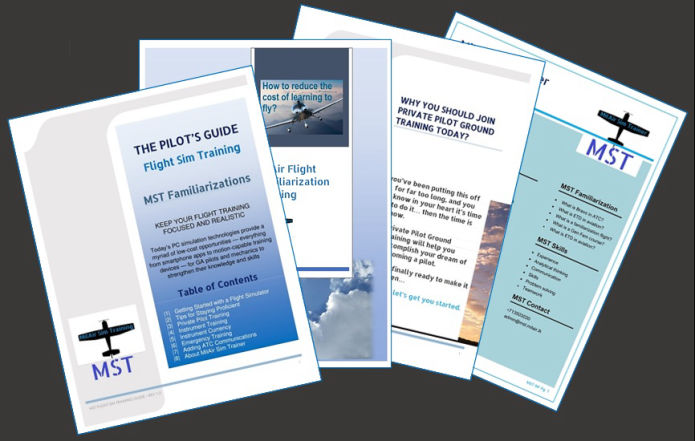
|1| Getting Started with a Flight Simulator
|2| Tips for Staying Proficient
|3| Private Pilot Training
|4| Instrument Training
|5| Instrument Currency
|6| Emergency Training
|7| Adding ATC Communications
|8| About MilAir Sim Trainer

CONTENTS 

MilAir Sim Trainer (MST) Introduction
Step 1: Decide on Training Flight Objectives
Step 2: Incorporate Flight Details

Sample MST Scenario for IFR/VFR Familiarization Mission:
- Your friend Rohan has volunteered for a project in Beruwala Marine Museum. Project needs
photos and videos of a pod of whales found along seas close to southern coast. You are
currently in Ratmalana (VCCC) and plan to pick Rohan up at Katukurunda (VCCN) and then
continue over the coastline at 1500ft AGL and reach Koggala (VCCK).
- Then proceed over the sea for photography and filming.
- When assignment is completed return to Ratmalana via Katukurunda.
- Detailed flight plan will be available 1hr before the flight.

CONTENTS

STAGE 1: Pre-Solo
 PHASE 1: Learning Your Airplane
  S1P1-SCENARIO 1: Your First Flight
  S1P1-SCENARIO 2: Controlling the Airplane
  S1P1-SCENARIO 3: Increasing Awareness
  S1-Phase 1 Ground Training Checklist
 PHASE 2: Improving Control
  S1P2-SCENARIO 1: Recognizing & Recovering from Stalls
  S1P2-SCENARIO 2: Correcting for the Wind in Flight
  S1P2-SCENARIO 3: Making Steep Turns
  S1-Phase 2 Ground Training Checklist
  S1P2-SCENARIO 4: Progress Check
 PHASE 3: Takeoffs and Landings
  S1P3-SCENARIO 1: Takeoffs and Landings
  S1P3-SCENARIO 2: Crosswind Takeoffs and Landings
  S1P3-SCENARIO 3: Emergency Operations and Landing Practice
  S1-Phase 3 Ground Training Checklist
 PHASE 4: Preparing for Solo Flight
  S1P4-SCENARIO 1: Using Your Flight Display / Instruments to Control the Airplane
  S1P4-SCENARIO 2: Handling the Unexpected
  S1P4-SCENARIO 3: Getting Ready for Solo Flight
  S1-Phase 4 Ground Training Checklist
 PHASE 5: First Solo
  S1P5-SCENARIO 1: Progress Check
  S1-Phase 5 *Progress Check*- Oral / Flight
  S1P5-SCENARIO 2: Your First Solo Flight
  S1P5-SCENARIO 3: Your Second Solo Flight
  S1-Phase 5 Proficiency Checklist

STAGE 2: Solo Flight and Cross-Country
  S2-SCENARIO 1: Solo Flight Beyond the Pattern
  S2-SCENARIO 2: Using Short- or Soft-Field Techniques
  S2-SCENARIO 3: Using Electronic Navigation / Instrument Flight
  S2-SCENARIO 4: Solo Practice
 PHASE 6 Ground Training Checklist
 PHASE 7: Flying Cross-Country

  S2P7-SCENARIO 1: Going Cross-Country
  S2P7-SCENARIO 2: Polishing Your Cross-Country Skills
  S2P7-SCENARIO 3: PROGRESS CHECK
  S2-Phase 7 Progress Check - Oral / Flight
  S2P7-SCENARIO 4: Your First Solo Cross-Country
  S2-Phase 7 Ground Training Checklist
 PHASE 8: Flying at Night [Private Pilot only]
  S2P8-SCENARIO 1: Flying at Night
  S2P8-SCENARIO 2: Flying Cross-Country at Night
  S2-Phase 8 Ground Training Checklist
 PHASE 9: Advancing Your Skills
  S2P9-SCENARIO 1: Polishing Emergency Instrument Skills
  S2P9-SCENARIO 2: Solo Cross-Country Practice
  S2P9-SCENARIO 3: Long Solo Cross-Country
  S2P9-SCENARIO 4: More Solo Practice
  S2-Phase 9 Ground Training Checklist

STAGE 3: Preparing for your Practical Test
  S3P10-SCENARIO 1: Mock Practical Test
  S3P10-SCENARIO 2: Final PROGRESS CHECK
  S3-Phase 10 Ground Training Checklist

CONTENTS  

Ground Phase 1 - Detailed Study
Ground Phase 2 - Introduction to Navigation Aids – VOR & NDB 
 The Instruments
 The Priority Scan
 Take Off and Climbing
 Descending
 Turning – Rate 1, 30 & 45 degrees
 Partial Panel Flying
 Unusual Attitude Recovery 
 Flying on Instruments
 Procedure Turns
 Simulator Training Phase

Instrument Flying Phase

Lesson Objectives 

1. To be able to read Jespersen Charts and know what international airports are like
2. To fly a Departure
3. To fly an Arrival
4. To know how to go into a hold and know what fuel you have
5. To perform an ILS approach from Radar Vectors and execute a Go Around
6. Perform a VOR Approach
7. Perform a NDB Approach
8. Perform a Circle to land Approach 

Above the Clouds

How do we protect ourselves from bad aeronautical decision-making (ADM)? One way is to learn from others’ mistakes. ADM begins well before the wheels leave the ground. In fact, the decision-making to scrub a flight should start the moment you roll out of bed, rubbing the sleep out of your eyes.

Situation 
Every once in a while, unforeseen circumstances or events can build up to require a concentration and ability to think clearly under pressure. The freezing fog/low cloud had not burned off after sunrise as forecast, with a ceiling of about 150 feet. Could you hold in the stack and wait for the fog/low cloud to clear – but what if it didn’t? We would paint ourselves into a corner as the fuel was consumed.

Skill 
Knowing your personal limits amid a myriad of potential factors is incredibly important. In the world of aviation, bad decisions can be more than a mere inconvenience or life lesson. In fact, they can be the last poor decision you ever make.

CONTENTS 

Class 1: Airborne Airplanes
Class 2: How Airplanes Turn
Class 3: Climbs
Class 4: Slow Flight
Class 5: Takeoffs
Class 6: Landings
Class 7: Taxiing the Aircraft
Class 8: Stalls
Class 9: Steep Turns
Class 10: The Traffic Pattern
Class 11: Crosswind Landings
Class 12: VOR Navigation
Class 13: Step 1 of the Instrument Scan
Class 14: Step 2 of the Instrument Scan
Class 15: Step 3 of the Instrument Scan
Class 16: Instrument Approaches
Class 17: Flying an ILS Approach
Class 18: Holding Patterns

CONTENTS

STUDENT GROUND AND FLIGHT TRAINING RECORD

COURSE OBJECTIVES
- COMPLETION STANDARDS
- CLASSROOM AND EQUIPMENT
- ADDITIONAL TRAINING AIDS

FURTHER SUGGESTED READING
- PRIMARY AIRPORT FACILITIES
- TRAINING AIRCRAFT

COURSE TIME ALLOCATION TABLE

GROUND TRAINING COURSE OUTLINE
- GROUND TRAINING COURSE OBJECTIVES
- GROUND TRAINING STAGE I
- GROUND TRAINING STAGE II
- GROUND TRAINING STAGE III

GROUND TRAINING COURSE COMPLETION STANDARDS

FLIGHT TRAINING COURSE OUTLINE
- FLIGHT TRAINING COURSE OBJECTIVES
- FLIGHT TRAINING STAGE I
- FLIGHT TRAINING STAGE II
- FLIGHT TRAINING STAGE III

FLIGHT TRAINING COURSE COMPLETION STANDARDS  

CONTENTS

1. Common requirements
2. Syllabus of Flight Instructions
3. Skill test
4. Experience requirements and crediting
5. Experience requirements
6. Syllabus of flight instructions
      i) Familiarisation with the aeroplane
     ii) Emergency drills
    iii) Preparation for and action after flight
    iv) Air experience: flight exercise
     v) Effects of controls
    vi) Taxiing
   vii) Emergencies: brake and steering failure
  viii) Straight and level
    ix) Climbing
     x) Descending
    xi) Turning
   xii) Slow flight
  xiii) Stalling
  xiv) Spin avoidance
   xv) Take-off and climb to downwind position
  xvi) Circuit, approach and landing
 xvii) Emergencies
xviii) First solo
  xix) Advanced turning
  xxi) Precautionary landing
 xxii) Navigation
xxiii) Navigation problems at lower levels and in reduced visibility
xxiv) Radio navigation
 xxv) Basic instrument flight

    ^    

If you don't think you're the best pilot in the business, MAYBE you're in the wrong business.
& if you think you could never make a mistake, you are REALLY in the wrong business.


MST © Copyright 2024-2025